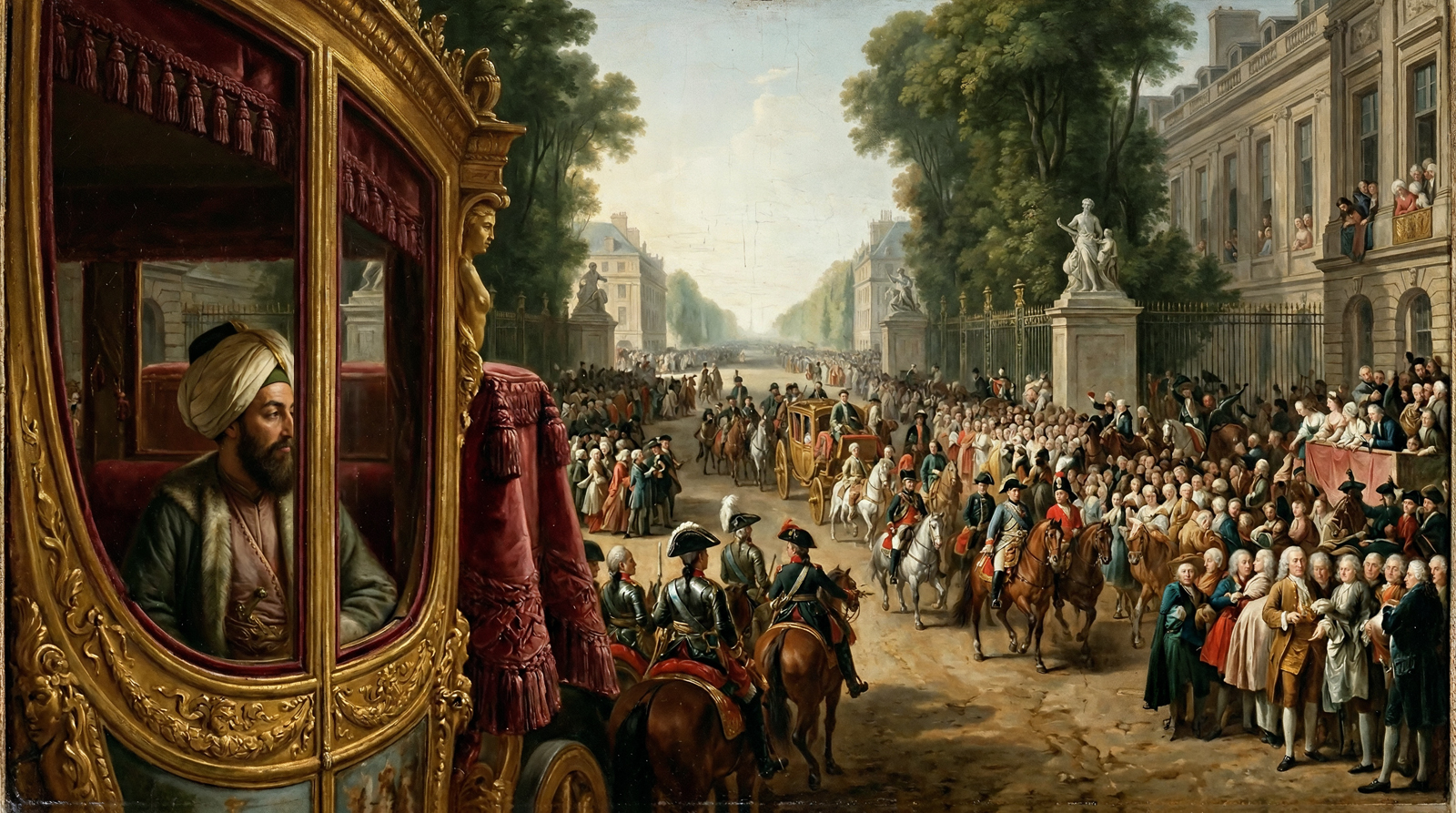
En önde kralın kendisine ait altı atlı askerlerinden bir alay yürüdü. Ardından bizim adamlarımızı ata bindirip bir kısmına kürk giydirmiş, ellerine tüfek vermiştik ; bir kısmına ise kerrake (ince üstlük) giydirip ellerine mızrak vermiştik, onları yürüttük. Arkalarından ağalar sınıfından sakallı olanlar yürüdü ; sonra İmam Efendi ve Kapıcılar Kethüdası, ondan sonra da oğlumuz ile kethüdamız at başı (yan yana) gittiler. Arkalarından altı adet yedek, ağır işlemlerle süslü ve eyerlenmiş at çekilip hazırlıklar tamamlanınca, kralın ahırcıbaşısı ve tercümanı ile birlikte biz de divan kilimi ve abasıyla eyerlenmiş bir ata bindik. Solumuzda Mareşal, sağımızda İntrodüktör olduğu halde harekete geçildi. Hemen arkamızdan da birer alay atlı dizildi ve bundan sonra arabalar sırasıyla yerini aldılar.
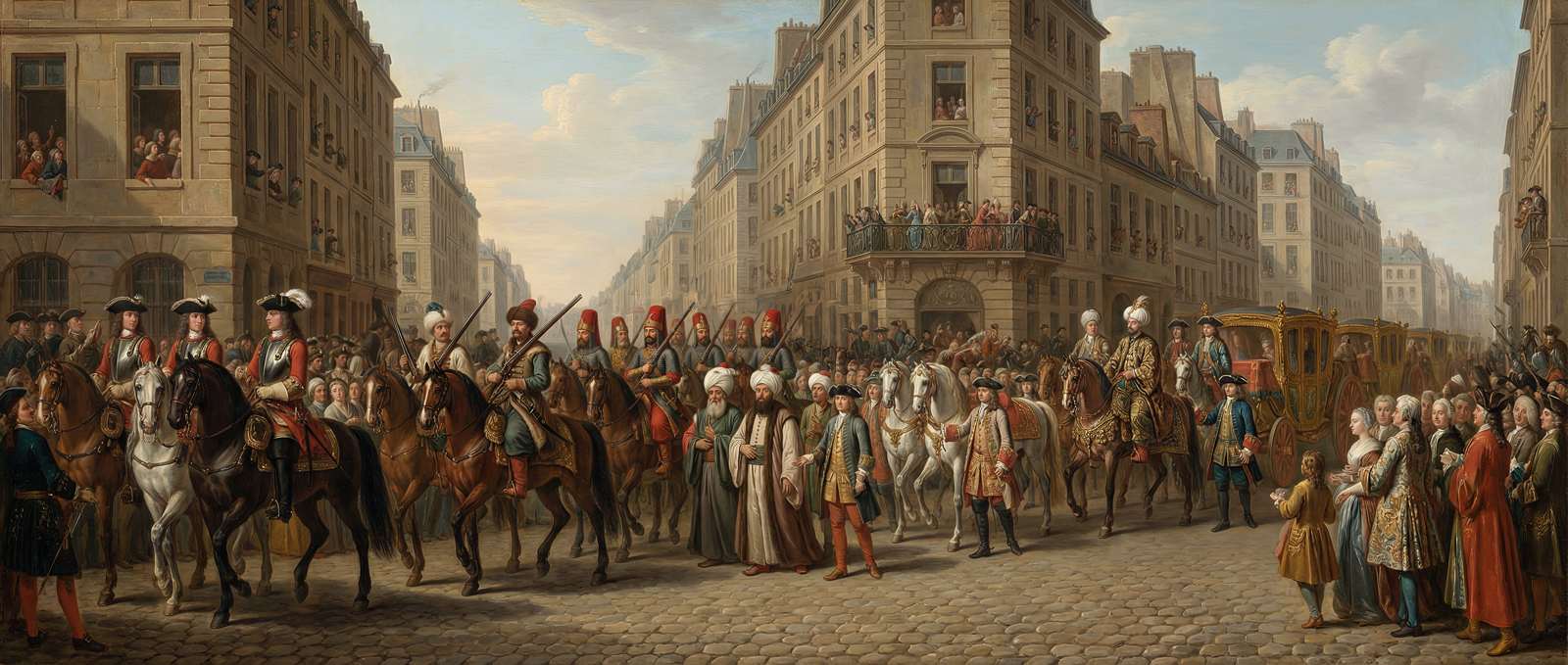
Un ambassadeur ottoman à Paris : Le régiment de cavalerie du roi ouvrit la marche. Il était suivi d’une partie de mes gens à cheval, certains vêtus de pelisse et fusils en main, d’autres avec le kercket (étoffe fort légère) et munis de lances. Derrière eux marchaient les « agas » (chefs) portant la barbe. Ils précédaient l’imam efendi et le kapigidlar kerkudassi (maître des cérémonies), à la suite desquels mon fils et mon intendant prenaient place. Suivaient six chevaux de main magnifiquement harnachés, menés par l’écuyer du roi et l’interprète. Je marchais ensuite avec le sarik (mousseline qui entoure le turban des Turcs) de cérémonie et un feredgé (pardessus avec des manches larges) doublé d’une pelisse de martre-zibeline, monté sur un cheval équipé d’un harnais et d’une bride divan, le maréchal à ma droite et l’introducteur à ma gauche. La marche était fermée par un second régiment de cavalerie, suivi par les carrosses, rangés selon leur rang.
An Ottoman Ambassador in Paris : The King’s regiment cavalry, led the march. It was followed by part of my men on horseback, with their pelisses and muskets in hand, and behind them another group carrying the kercket (a very light fabric) and lances, with a few « agas » wearing beards marching further behind. They preceded the Imam Efendi and the Kapigidlar Kerkudassi (master of ceremonies), after whom my son and my steward took their place. Following them were six splendidly harnessed horses, attended by the King’s equerry and the interpreter. I then marched, wearing the ceremonial sarik (muslin wrapped around the Turkish turban) and a feredgé (outer robe with wide sleeves) lined with a sable-marten pelisse, mounted on a horse equipped with a divan harness and bridle. The Marshal took my right and the Introducer my left. The march was closed by a second regiment of cavalry, after which the carriages fell into place according to their rank.
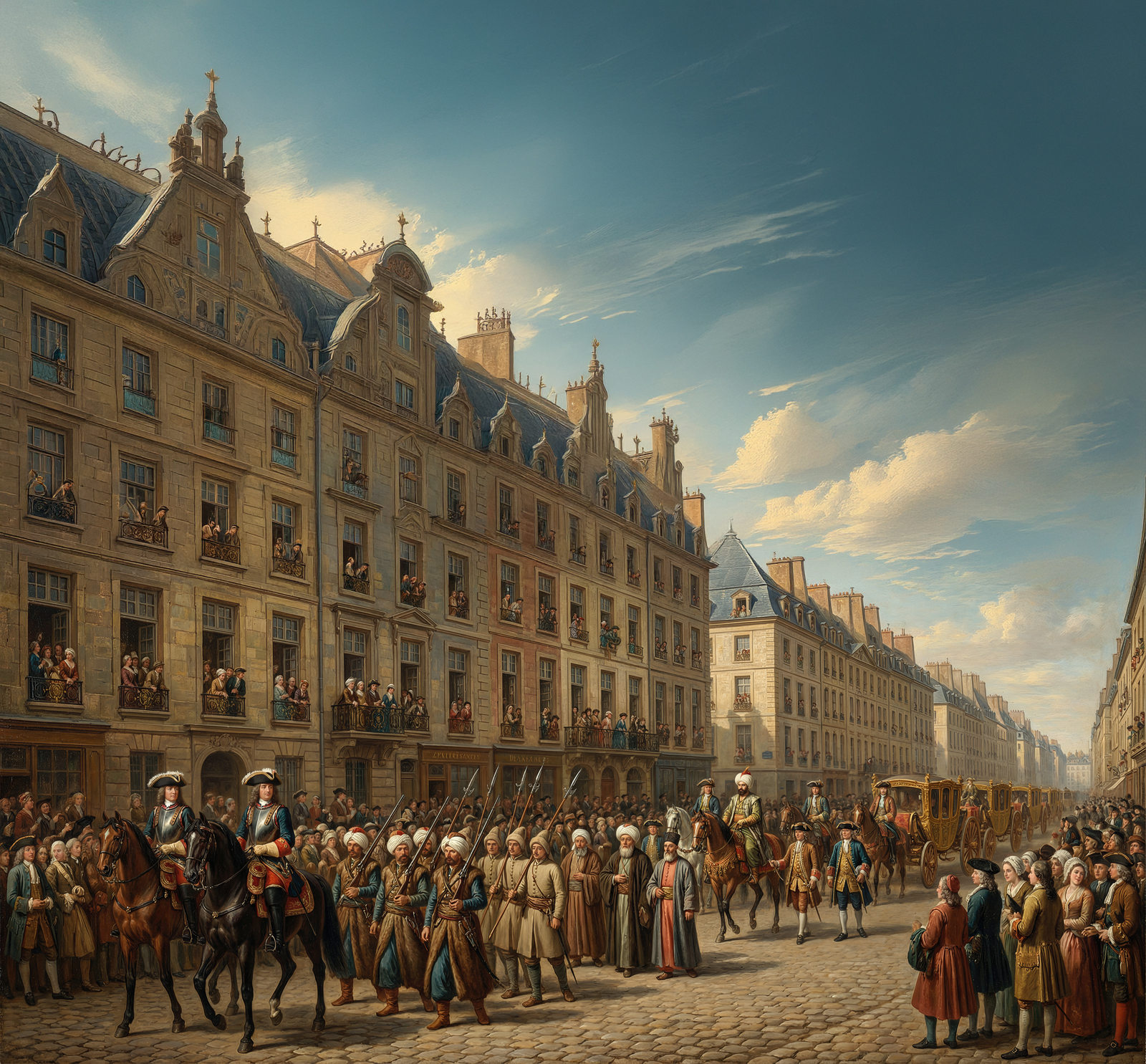
Paris şehrinin sokakları oldukça geniştir. Yan yana beş altı arabanın gitmesi mümkünken, bazı yerlerde halkın kalabalığından dolayı üç atlı yan yana güçlükle geçebiliyorduk. Sanki şehirdeki bütün halk bir töreni izlemeye gelmiş gibiydi. Evler dörder beşer katlıdır ve pencereleri sokağa bakmaktadır. Her pencere, alabileceği kapasiteden fazla kadın ve erkekle dolup taşmıştı.
Les rues de Paris sont assez larges. Là où cinq ou six carrosses pouvaient se croiser, nous ne pouvions, à certains endroits, passer que difficilement avec trois carrosses en raison de la foule. On aurait dit que toute la ville était venue assister à la cérémonie. Les immeubles ont quatre ou cinq étages et leurs fenêtres donnent sur la rue. Chaque fenêtre débordait de femmes et d’hommes, bien au-delà de ce qu’elle pouvait contenir.
The streets of Paris are quite wide. Where five or six carriages could pass side by side, in some places we could barely fit three carriages because of the crowd. It seemed as if the entire population of the city had come to witness the ceremony. The houses have four or five stories, and their windows face the street. Every window overflowed with men and women, far beyond what it could normally hold.